Three real iSuporta client engagements — e-commerce, SaaS, and professional services — showing what dedicated Philippines outsourcing actually costs, how fast ROI arrives, and why the dedicated model consistently outperforms shared BPO pools.
A US customer support rep costs $45,000–$55,000 a year in base salary — before benefits, payroll taxes, or turnover. A comparable dedicated specialist through iSuporta in the Philippines runs $8,000–$12,000. That gap is why small businesses with tight margins are moving fast on Philippines outsourcing. Here's what the numbers actually look like once they do.
TL;DR — Key Results at a Glance
-
E-commerce store: Cut support costs 62%, response time from 18 hrs to under 2 hrs, Trustpilot 3.2 → 4.6 stars in 90 days.
-
SaaS startup: 3x output volume, $9/hr all-in vs $25/hr US quotes, founder reclaimed 15 hrs/week.
-
Accounting firm: Same back-office output for $1,600/month instead of $4,800 — $3,200/month saved.
-
Common thread: Dedicated teams beat pooled BPO every time, and the 60-day ramp is the real breakeven point.
60–65% average labor cost reduction reported by iSuporta clients
60–90 days to ROI break-even for most clients
Why US Small Businesses Are Outsourcing to the Philippines
US labor costs are pricing small businesses out of scaling. A three-person support team easily runs $180,000 annually — money most sub-$5M businesses cannot spend while simultaneously investing in growth.
The Philippines has become the default destination for US small business outsourcing. Not just because of cost, but because of English fluency, cultural alignment with US customers, and a mature BPO infrastructure built across two decades. The case studies below come from real iSuporta client engagements (details anonymized at client request). They show what happens when the model is executed properly: dedicated teams, US management oversight, clearly defined roles from day one.
 Wide editorial photograph of a high-energy Manila BPO floor at golden hour — rows of Filipino custom
Case Study 1: E-Commerce Store Cuts Customer Support Costs by 62%
Client: US-based Shopify store, $2M annual revenue, 3-person in-house support team.
Problem: $147,000 per year on support staff. Response times averaging 18 hours. A Trustpilot rating of 3.2 stars — actively hurting conversions. The team was reactive, burned out, and adding headcount wasn't viable at current margins.
Solution: iSuporta placed a 2-agent dedicated customer support team trained on the store's Shopify workflows, return policy, and escalation playbook. Full onboarding took under three weeks.
Result: Annual support costs dropped to $56,000 — a 62% reduction. Average response time fell to under 2 hours. Trustpilot climbed from 3.2 to 4.6 stars within 90 days. The store reinvested the savings into paid acquisition, which returned far more than the labor cost difference alone.
For a closer look at what this kind of engagement costs and how to structure it, the Philippines customer support outsourcing cost guide breaks down hourly rates, team structures, and what to negotiate.
Key Takeaway A Trustpilot lift from 3.2 to 4.6 stars isn't a vanity metric. It directly affects conversion rate on every product page displaying a review widget. This store's outsourcing investment paid for itself in recovered revenue — not just saved labor.
Case Study 2: SaaS Startup Scales Data Operations 3x Without Hiring Locally
Client: B2B SaaS startup, Series A stage, Austin, TX.
Problem: The founder was personally handling data entry and lead enrichment — 15 hours per week of operational work pulling them away from sales and product. US-based VA quotes came in at $25/hour. A part-time hire wasn't viable given their burn rate.
 Close-up editorial portrait of a Filipino data specialist in a sun-lit Cebu home office — two wide m
Solution: iSuporta placed one dedicated data and lead generation specialist trained on the startup's CRM stack and enrichment process. All-in cost: $9/hour for entry-level to mid-tier roles — see the Philippines salary guide for full rate ranges by function.
Result: Output volume tripled within 45 days. The founder reclaimed 15 hours per week. A two-month backlog cleared in under four weeks. For context on how dedicated offshore staffing compares to shared BPO pools: shared models rotate staff and never build institutional knowledge. Dedicated models do. That difference shows up fast.
"We went from a 2-week backlog to same-day turnaround in the first month."
The $9/hour all-in rate versus a $25/hour US alternative isn't just a cost savings — it's what made the hire possible at all. Roles that were previously unaffordable become viable. That's the real unlock for early-stage companies.
Did You Know? The Philippines produces roughly 800,000–1,000,000+ college graduates annually (Commission on Higher Education, 2024) — a large share in business, IT, and communications. English is an official language and the medium of instruction. Written quality and accent neutrality hold up for US clients because the education system is built around them.
Case Study 3: Professional Services Firm Outsources Back Office, Saves $3,200/Month
Client: US accounting firm, 4 partners, 200 active clients.
Problem: $4,800/month on a US-based bookkeeping contractor plus an admin assistant — two vendor relationships, inconsistent availability, no turnaround SLA. During tax season, the model broke entirely.
Solution: iSuporta placed one bookkeeping specialist and one VA under a single engagement. Both operate under NDA with data handling protocols aligned to the Philippines Data Privacy Act — a non-negotiable for any firm handling client financial records.
Result: Same output. Same client load. Same turnaround benchmarks. Total cost: $1,600/month — $3,200 saved per month, $38,400 annualized. ROI payback period: 8 months, accounting for onboarding time. For a 4-partner firm, that's a real shift in profitability. The firm has since expanded its Philippines bookkeeping team to handle overflow during peak periods.
"Tax season used to be the point where everything fell apart. This year the team held — same turnaround, no scrambling."
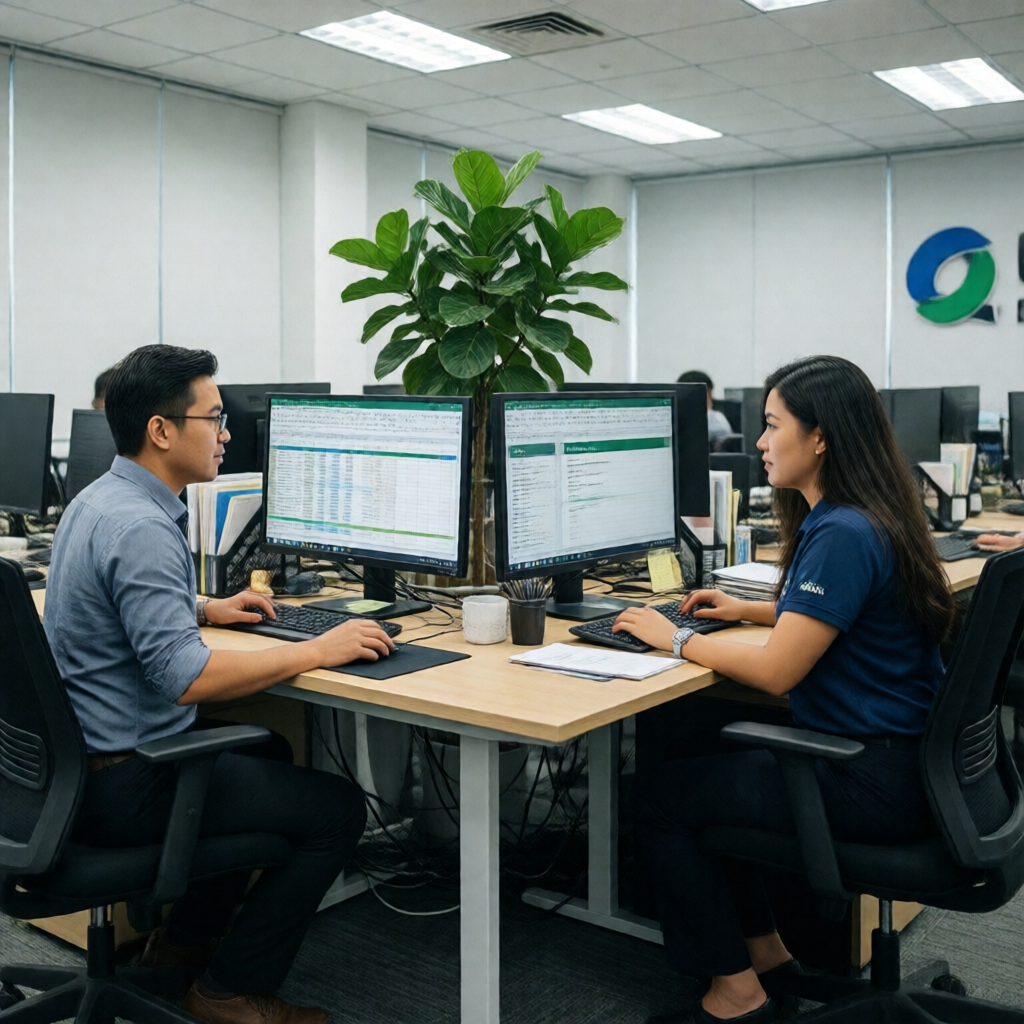 Wide-angle editorial photograph of a professional Cebu outsourcing office — a Filipino bookkeeping s
See If Your Business Qualifies →
What These Results Have in Common
Three different business types. Three different problems. The same structural pattern produces results every time.
| | Dedicated Philippines Team | Shared BPO Pool | US In-House Hire |
| Cost / hr (all-in) | $8–$12 | $12–$18 | $22–$35+ |
| Ramp time | 2–4 weeks | 4–8 weeks | 4–12 weeks |
| Knowledge retention | High — same agent stays | Low — agents rotate | High — if they stay |
| Management overhead | Low (US account layer) | Medium | High |
-
Dedicated teams outperform shared BPO models. Shared agents cycle between clients and never build deep product knowledge. Dedicated agents own the role — they learn your stack, your tone, your edge cases.
-
The 60-day ramp is the real breakeven point. Every engagement has a learning curve. Clients who see the fastest ROI invest in a proper onboarding process in weeks one through four — and don't measure cost savings before the ramp completes.
-
US management oversight closes the offshore communication gap. iSuporta's model includes a US-side account layer, so you're not managing timezone confusion or garbled briefs. That's the difference between outsourcing as you've heard it described and outsourcing that actually works.
For a structured view of how the engagement model works, the full process walkthrough covers hiring, onboarding, and the management handoff. If you're still comparing options, the step-by-step guide to outsourcing to the Philippines is the clearest starting point for first-timers.
Frequently Asked Questions
Are these Philippines outsourcing case studies from real iSuporta clients?
Yes. All three are based on real client engagements. Details have been anonymized at client request, but the cost figures, timelines, and outcomes reflect actual results. Attributed testimonials are available on the iSuporta case studies page.
How quickly do businesses typically see ROI from Philippines outsourcing?
Most iSuporta clients reach break-even within 60–90 days. The SaaS and e-commerce clients above saw measurable results within the first 30 days — largely because dedicated team structures allow faster knowledge transfer than shared BPO pools.
What types of roles get the best results when outsourcing to the Philippines?
Customer support, data entry, virtual assistance, bookkeeping, and lead generation consistently deliver the highest ROI. For role-specific rate benchmarks, the Philippines outsourced salary guide breaks down cost ranges by function.
The math on Philippines outsourcing isn't complicated — the cost gap is real, and the dedicated model turns it into a repeatable business advantage. The only question is which role you start with.
Bottom Line
The three case studies above share one pattern: a business that replaced a shared BPO arrangement — or a costly local hire — with a dedicated Philippines team, measured the gap, and scaled. Average savings ran 62–67% against equivalent US roles, without sacrificing output quality or management control.
-
E-commerce: Support costs dropped from $147K to $56K annually; Trustpilot rose from 3.2 to 4.6 stars in 90 days.
-
SaaS startup: Output tripled, backlog cleared in 4 weeks, founder reclaimed 15 hours per week.
-
Accounting firm: Back-office costs fell from $4,800 to $1,600/month — $38,400 saved per year — with the same output through tax season.
Every one of them started with a single well-defined role. The model works at small scale first. Start there, measure it, then expand — that's the repeatable version of this.