Most US businesses that set out to build a remote customer support team in the Philippines get the sequence wrong — cheap hire first, system second. High turnover follows. Service suffers. The team never scales. Reverse the order and you can have a fully operational, managed CS team running within three to six weeks, at a fraction of domestic cost.
Here's the playbook. It's the same framework e-commerce, SaaS, and healthcare businesses use to cut support costs by over 60% — without sacrificing quality.
TL;DR — The 5-Step Build at a Glance
-
Step 1: Define your support scope — channels, volume, hours.
-
Step 2: Choose your hiring model — BPO vs. freelance VA.
-
Step 3: Write tight role specs and screen for English fluency, empathy, and tool experience.
-
Step 4: Set up your tech stack before day one.
-
Step 5: Run a structured two-week onboarding ramp with SOPs and mock tickets.
Why the Philippines Keeps Winning for Remote Customer Support
Two things set the Philippines apart: near-native English and a service culture baked into the national identity. The country has been the world's second-largest BPO market for over a decade — the talent pipeline, management infrastructure, and time-zone compatibility for US businesses are established, not emerging. Most Philippine CS teams cover US business hours without friction.
 Editorial photograph of a Filipino customer support professional at a sleek BPO workstation in Bonif
$600–$900 per month, avg Filipino CS agent (managed BPO)
$3,500+ per month, equivalent US-based CS role
That's 60–75% less — and the gap widens once you add US employer taxes, benefits, and recruiting overhead. For a position-by-position breakdown, our Philippines salary guide by role for 2026 runs the full numbers.
The 5 Steps to Build Your Remote CS Team
1 Define Your Support Scope Before you hire, answer three questions: Which channels do you need covered — email, live chat, phone? What's your daily ticket volume? Do you need 24/7 coverage or US business hours only? This single document shapes every hiring and tech decision that follows.
2 Choose Your Hiring Model This is the biggest fork. A freelance VA is cheaper upfront but drops compliance, training, and management entirely on you. A managed BPO like iSuporta handles employer-of-record obligations, local HR, and recruits to your spec — you manage output. Building a team of two or more? The VA vs. dedicated remote team comparison is worth reading before you commit.
 Split-screen editorial photograph — left half shows a US entrepreneur in a sunlit Austin home office
3 Write Role Specs That Screen for the Right Things English fluency is baseline. What separates great CS hires is written empathy, composure under pressure, and demonstrated tool experience — Zendesk, Freshdesk, Intercom. Add one scenario question to your application: "A customer emails saying their order is two weeks late. Write your response." Skill and tone surface immediately.
4 Set Up Your Tech Stack Before Day One Don't let your team troubleshoot access issues during their first week. Get them set up on your helpdesk (Zendesk or Freshdesk), Slack for async comms, and Loom for training videos before they start. A shared knowledge base — even a basic Google Doc — cuts average handle time in the first 30 days.
5 Run a Two-Week Structured Onboarding Ramp Week one: SOPs, product walkthroughs, shadow sessions. Week two: mock tickets with feedback, then live tickets under supervisor review. Most teams hit full productivity by day 14. Skipping this ramp is the single most common reason offshore CS teams underperform in their first 90 days.
Unsure how to evaluate BPO options during Step 2? Our guide on how to choose an outsource agency in the Philippines walks through every question worth asking before you sign anything.
Managing Your Philippine CS Team for the Long Haul
Hiring well gets you started. Retention is where most US owners lose the plot. Filipino work culture places real weight on pakikisama — team harmony and belonging — which means recognition and communication cadence matter more than they do with a typical domestic team.
"You don't manage a Philippine CS team — you lead it. The ones that thrive treat their offshore team like an extension of the company, not a cost center."
Track the KPIs that actually tell you something: CSAT score, First Response Time, Average Handle Time, and ticket deflection rate. Weekly 1:1 video check-ins take 20 minutes each and eliminate most of the friction that quietly becomes attrition. One thing many US owners miss: the 13th month pay is a legally mandated annual bonus in the Philippines, due by December. A managed BPO handles it automatically — no surprises.
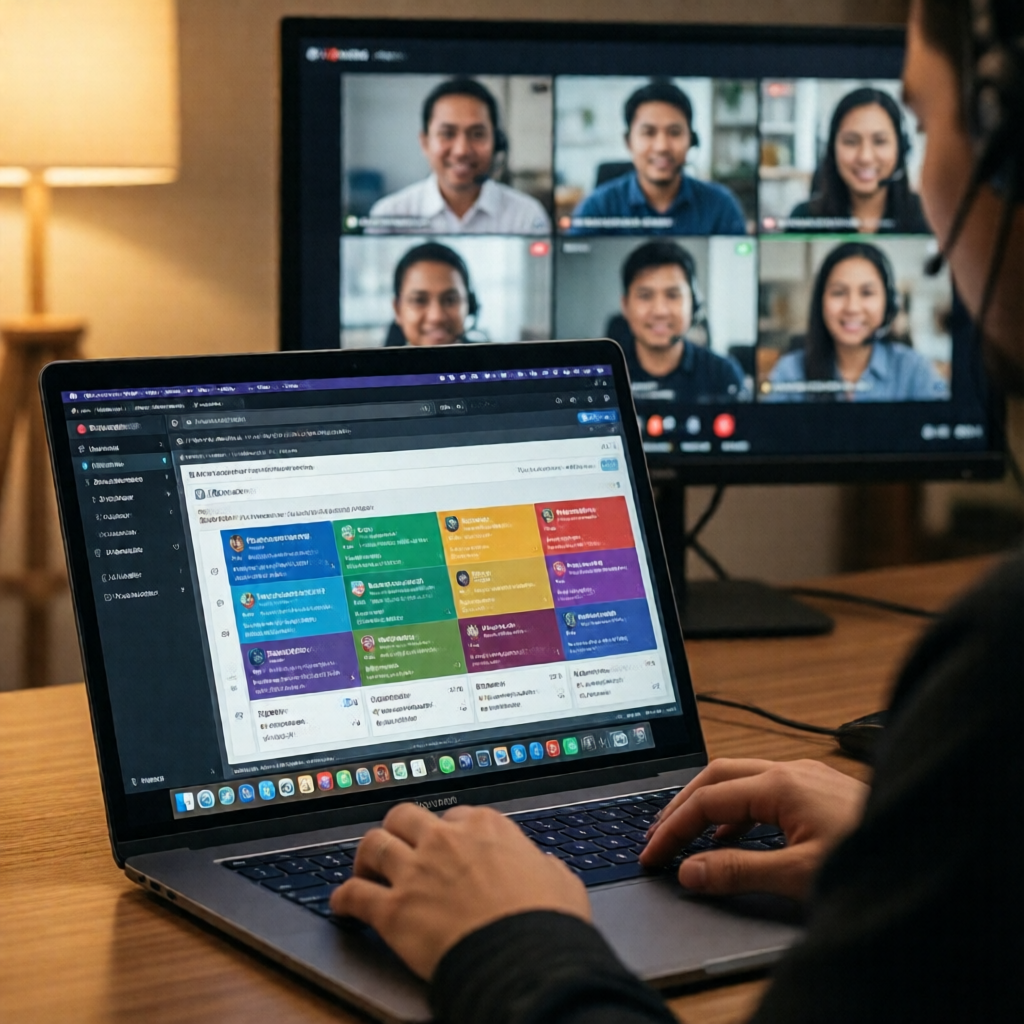 Over-the-shoulder editorial view of a laptop screen displaying a live CSAT dashboard and color-coded
Key Takeaway Teams managed with weekly video check-ins and clear KPI dashboards show meaningfully lower attrition in the first year. The gap between structured and unstructured management is often the difference between a team that sticks and one that churns every six months.
A pattern we see constantly: a SaaS founder builds a four-person Philippine CS team through a managed BPO, sets up weekly CSAT reviews, and gives each agent a 90-day career path. Year-one turnover? Zero. For the full approach to managing across time zones, our piece on managing your outsourced Philippines team — tools, KPIs, and culture covers it in depth.
Did You Know? The Philippines employs over 1.3 million people in the BPO sector — one of the most experienced CS talent markets on the planet. From fiber internet availability to English-medium education, the entire infrastructure exists to support remote work for US companies.
For a broader view of offshore team structures that scale, the offshore staffing guide for US dedicated remote teams is worth bookmarking. And if you want to see the model in action before committing, iSuporta's case studies show real team builds with real outcomes.
The Bottom Line Building a remote customer support team in the Philippines takes 3–6 weeks with the right BPO partner and a clear scope going in. Follow the five steps, track the right KPIs, and invest 20 minutes a week per agent in direct communication — and you'll run a CS operation that outperforms most US domestic teams at over 60% less cost.
Frequently Asked Questions
How long does it take to build a remote customer support team in the Philippines?
With a managed BPO partner, most US businesses are fully onboarded within 3–6 weeks. That timeline covers recruiting, compliance setup, and the two-week training ramp. The freelance route takes longer because recruiting and HR screening fall entirely on you.
What does a remote Filipino customer support agent cost in 2026?
Expect $600–$900/month per agent all-in through a managed BPO — versus $3,500+ for a US-based equivalent, before benefits and employer taxes. For a full role-by-role breakdown, see our Philippines salary guide for 2026.
Do I need to handle Philippine labor law compliance myself?
Not with a managed BPO. iSuporta handles employer-of-record responsibilities, 13th month pay, SSS/PhilHealth contributions, and all local compliance. You manage output and quality — the administrative overhead stays off your desk entirely.
Should I use a BPO or hire freelance VAs for customer support?
For a single-agent test, a VA can work. For a team of two or more — especially handling sensitive customer data or carrying SLA accountability — a managed BPO delivers consistency, coverage redundancy, and built-in compliance. The full comparison lives in our VA vs. dedicated team guide.
The model works. The only question is whether you build it yourself or use a partner who's done it hundreds of times already.
Ready to Build Your Philippine CS Team? iSuporta handles recruiting, compliance, and day-to-day HR — you just manage output. See how it works or get a custom team quote.
Get a Free Team Quote See How iSuporta Works
Bottom Line Philippine customer support teams offer a rare combination: English fluency, cultural alignment with Western service expectations, strong work ethic, and labor costs 60–80% below US equivalents. For SMBs scaling support without scaling headcount costs, a managed BPO like iSuporta removes the hardest parts — recruiting, compliance, redundancy — and leaves you running the operation, not administrating it. If you're handling more than 50 tickets a day with a solo agent or no agent at all, the math on a dedicated team almost always works.