Comparing the Philippines and India for outsourcing? Here's the verdict: the Philippines wins for most operational and customer-facing roles — stronger English fluency, near-perfect US time zone alignment, and rates that match or beat India across the board. India earns the edge at enterprise engineering scale only. Two sentences. The data follows.
TL;DR — Philippines vs India for US Small Businesses
-
Philippines rates: $8–15/hr vs India's $10–20/hr for equivalent non-tech roles
-
India pulls ahead for 50+ engineer teams and enterprise-scale IT infrastructure
-
For 1–20 outsourced roles in ops, support, or admin — Philippines wins every time
Philippines vs India at a Glance: Role-by-Role Rates (2026)
The rates below reflect current market ranges for skilled, English-fluent staff. For the full breakdown across 20+ positions with seniority bands, see the Philippines salary guide by role.
 Overhead editorial shot of a Filipino BPO team at polished glass workstations in a Makati high-rise
| Role | PH Rate ($/hr) | India Rate ($/hr) | PH Advantage |
| Virtual Assistant | $8–12 | $10–18 | Lower cost + better cultural fit |
| Customer Support Agent | $8–12 | $10–16 | Lower cost + accent advantage |
| Bookkeeper | $10–15 | $12–20 | Comparable talent, lower rate |
| Graphic Designer | $10–15 | $12–20 | Strong design talent pool |
| Software Developer | $15–25 | $20–35 | Good for small dev teams |
The 4 Deciding Factors for US Small Businesses
1. Cost: The Math Is Simple
For most non-technical roles, the Philippines runs $8–15/hr against India's $10–20/hr for equivalent talent. On a 3-person full-time team, that spread compounds fast — every single month.
$500–$1,000 estimated monthly savings with a 3-person PH team vs equivalent India hire (non-tech roles)
Run your own numbers by role and headcount with the Philippines cost savings calculator.
2. English Fluency and Accent — This One Actually Matters
The Philippines ranks consistently among the world's top countries on the EF English Proficiency Index. It has for over a decade. More important for US businesses: Filipino English carries a neutral accent that US callers respond to well. Indian English is excellent — but the accent-familiarity gap is real, and for inbound customer support, call abandonment from accent mismatch is a documented, measurable problem. Not a stereotype. A number that shows up in your CSAT scores.
Building a customer support team? This factor alone tips the scales.
 Close-up portrait in natural light — a Filipino woman mid-conversation on a wireless headset, warm o
3. Time Zone — The Hidden Advantage Nobody Talks About Enough
Philippine Standard Time (UTC+8) lets a Manila team work a midnight shift that maps cleanly to 9am–5pm US Eastern, or 6am–2pm Pacific. No async lag. No "we'll have that to you tomorrow morning." India Standard Time (UTC+5:30) overlaps with US Eastern for roughly 4–5 hours — workable for some tasks, crippling for live support or real-time collaboration.
💡 Did You Know? A Manila-based team on a night shift answers your 9am calls in real time — no async delay. India on IST would need to start their shift at 11:30pm to match that same coverage window.
4. Cultural Fit — More Than a Soft Metric
The Philippines spent over a century under US influence. American pop culture, English-language education, US-style business norms. It's not abstract. Filipino staff understand your humor, know your customer expectations, and don't need a cultural orientation manual to get up to speed.
"Filipino agents don't just speak English — they grew up watching the same shows as your customers. That shared context changes the quality of every interaction."
India has deep talent. But its corporate culture traces to British influence, and the calibration curve for US customer-facing roles is measurably longer. Business owners who have made the switch from India to the Philippines consistently report CSAT improvements within 60 days — not from scripting changes, but because conversations felt more natural to their customers.
When India Outsourcing Actually Makes More Sense
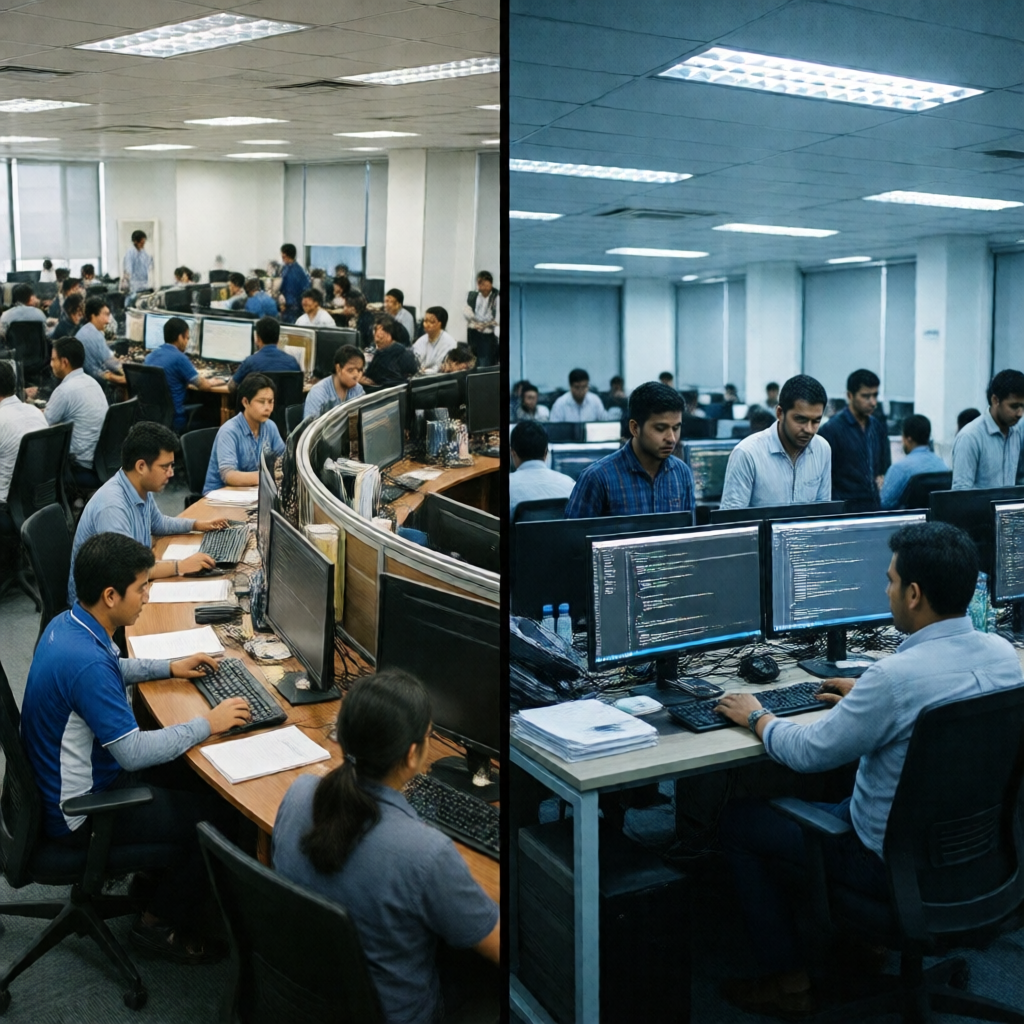 Diptych editorial, matched exposure — left panel: a Manila BPO floor alive with daytime customer-ser
India is not the wrong choice. It's the wrong choice for this use case.
India is the better fit IF…
-
You need 50+ software engineers — India's dev talent pool is deeper at scale
-
You're running enterprise-level IT infrastructure requiring 24/7 massive-volume operations
-
You need ML/AI research talent or deep data science expertise
-
You're sourcing from a globally recognized tech hub for investor optics
For US small businesses with 1–20 outsourced roles in operations, support, or admin — the Philippines wins on every practical metric. Weighing other nearshore options? The Philippines vs Mexico outsourcing comparison is worth a read.
Once you've decided on the Philippines, structure the engagement properly. Our guide on how to outsource to the Philippines covers hiring models, contracts, and onboarding — read it before you post a single job ad.
The Bottom Line The Philippines gives US small businesses better English fluency, stronger time zone overlap, and rates that match or beat India across most operational roles. India is a real competitor only at enterprise tech scale. For 1–20 seats in support, admin, design, or bookkeeping — the Philippines is the clear choice in 2026.
FAQ
Is the Philippines cheaper than India for outsourcing?
For most non-technical roles — virtual assistants, customer support, bookkeeping, admin — the Philippines is equal to or cheaper than India: $8–15/hr vs India's $10–20/hr for equivalent talent. India can edge lower for large-scale senior engineering engagements, but that advantage narrows fast for small teams.
Do Filipino workers speak better English than Indian workers?
The Philippines ranks consistently among the world's top countries on the EF English Proficiency Index and carries a neutral accent strongly preferred by US customers in call studies. For customer-facing roles, Filipino English is widely considered the best fit for US businesses — not just proficient, but culturally calibrated to how American customers actually communicate.
What's the time zone difference between the Philippines and India for US businesses?
Both countries sit at UTC+8 and UTC+5:30 respectively, but the operational gap matters. Philippine teams on a standard night shift align perfectly with US daytime hours coast to coast. India's IST overlap with US Eastern is only 4–5 hours — workable for async tasks, a genuine friction point for any team that needs real-time responsiveness.
Ready to build your Philippines team?
Get a custom staffing quote for your specific roles — we'll match you with vetted talent and handle the rest.
Get a Free Philippines Staffing Quote → Already comparing options? See our Philippines vs Mexico breakdown →
The Bottom Line
For US businesses in 2026, the Philippines vs India decision comes down to one question: what does your team actually need to do?
-
Customer-facing roles — Philippines wins on accent, cultural fit, and time zone alignment with US hours.
-
Technical development at scale — India's larger talent pool and established tech export infrastructure give it an edge for pure engineering volume.
-
Small-to-mid business operations — Filipino VAs and BPO staff deliver faster ramp times, stronger English retention, and lower coordination friction.
-
Cost — Both markets are competitive; the Philippines edges out India for CX-heavy roles when you factor in productivity and churn.
Most US small businesses building a remote team for the first time get better results starting in the Philippines. The soft advantages — communication clarity, cultural alignment, US-centric scheduling — compound over time in ways that raw rate comparisons miss.