A mid-size US AI lab was training a 7-billion-parameter instruction-following model with a four-person in-house labeling team in San Francisco. Turnaround on each preference-ranking batch: nine days. Inter-annotator agreement: 81%. Blended hourly cost: $47. Six months later — after shifting that pipeline to a Philippine RLHF team — those same batches close in 3.5 days, agreement sits at 93%, and the blended rate is $14 an hour. That's not a rounding error. That's a structural advantage.
- RLHF requires judgment and reasoning — not fast clicking — making annotator quality the primary cost driver, not volume.
- Filipino annotators rank #1 in Southeast Asia in the EF English Proficiency Index (EF EPI 2023), directly relevant to evaluating LLM output quality.
- The anonymized case study below shows a 61% faster turnaround, 12-percentage-point IAA improvement, and 70% cost reduction vs. US in-house.
- Inter-annotator agreement above Kappa 0.80 (~90% raw agreement) is the production threshold — here's the three-step quality stack that hits it.
RLHF vs. Data Labeling: Why the Distinction Matters for Outsourcing
Most people use "data labeling" as a catch-all. That's a mistake when you're evaluating vendors, because the four tiers of AI training work require fundamentally different annotator profiles — and you'll overpay or under-specify if you conflate them.
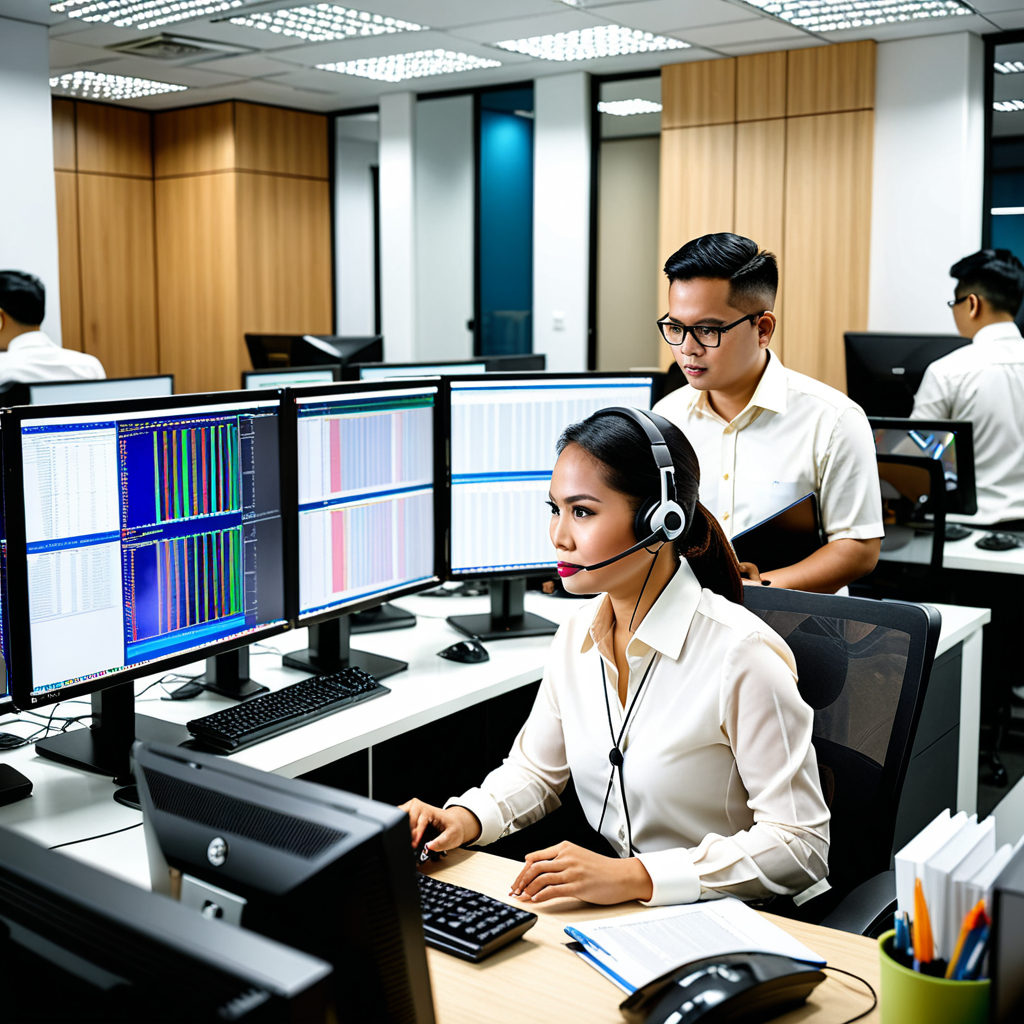
Here's the hierarchy in plain terms. Data labeling is tagging raw inputs — drawing bounding boxes, classifying images, transcribing audio. Speed matters most. Annotation adds structured metadata: intent labels, entity tagging, sentiment scoring. RLHF — Reinforcement Learning from Human Feedback is something else entirely: annotators compare pairs of model outputs and rank them by quality, safety, helpfulness, and instruction-following. Those rankings train a reward model that shapes the LLM's actual behavior. Bad RLHF data doesn't just slow you down; it actively degrades your model. Model evaluation sits at the top: scoring live outputs against detailed rubrics, often requiring domain expertise.
0.80
The implication for outsourcing decisions: you can offshore basic labeling almost anywhere. RLHF is a judgment task. The vendor's annotator profile — English fluency, analytical reasoning, calibration process — determines your reward model's ceiling.
Why Filipino Annotators Outperform on RLHF Tasks
Three factors converge in the Philippines that don't converge anywhere else at this price point.
"Evaluating whether a language model followed a nuanced instruction correctly is essentially a reading comprehension and critical thinking task. You can't outsource that to someone who struggles with the English being evaluated."
English fluency. The Philippines ranks #1 in Southeast Asia in the EF English Proficiency Index (EF EPI 2023) among non-native English-speaking countries. For RLHF work on English-language LLMs, that's the hard requirement. Annotators need to detect subtle instruction misalignment, evaluate tone, catch factual drift, and recognize when a response sounds plausible but is wrong. That demands genuine fluency, not functional comprehension.
Analytical grounding. High tertiary education rates in STEM and humanities disciplines produce evaluators capable of assessing logical coherence, factual accuracy, and ethical edge cases — skills that make RLHF preference judgments reliable at scale.
Cost structure. Blended annotator costs run 60–70% below equivalent US in-house roles. And the infrastructure is catching up to the talent. Pax Silica — the purpose-built technology ecosystem under development in New Clark City, Tarlac — is positioning the region as a serious long-term anchor for AI-adjacent work, with fiber redundancy, reliable power, and proximity to the Manila talent pool.
Case Study: Before & After (Anonymized AI Lab)
The archetype here is a mid-size US AI lab — roughly 60 employees, Series B — training a 7B parameter instruction-following model. Four in-house labelers in San Francisco. Competent team. But expensive, slow to scale, and operating with IAA numbers that wouldn't pass muster at a larger lab.
| Metric | Before (SF In-House) | After (iSuporta Philippines) |
|---|---|---|
| Batch turnaround | 9 days | 3.5 days (−61%) |
| Inter-annotator agreement | 81% | 93% (+12pp) |
| Blended hourly cost | $47/hr | $14/hr (−70%) |
| Team scalability | 4 annotators, weeks to hire | Elastic — up to 20+ in 72hrs |
The IAA jump from 81% to 93% came from two structural changes: a dual-review workflow on ambiguous preference tasks, and weekly calibration sprints where annotators align on rubric edge cases before touching live data.
Hitting >90% Inter-Annotator Agreement: The Quality Stack That Makes It Work
IAA is the make-or-break metric for RLHF data quality. A Kappa of 0.80 maps roughly to 90%+ raw agreement — that's the production floor most serious AI labs enforce before trusting a dataset for reward model training. Achieving it consistently at volume requires process, not just good hiring.
Every annotator's first 50 tasks are shadow-graded against gold-standard examples before going live. Weekly calibration sessions surface edge cases and resolve them with explicit guidance — front-loading alignment instead of discovering drift after 10,000 bad judgments.
Any preference judgment where the annotator's confidence falls below 80% triggers a second-reviewer assignment. Disagreements escalate to a lead evaluator. This catches the ambiguous middle-ground cases that inflate noise the most — without slowing down high-confidence tasks.
A lead evaluator reviews a random 10% sample of all completed tasks. Kappa scores are tracked per annotator and per task category. Anyone drifting below threshold gets a targeted calibration session before the next batch — not after three batches of bad data have already shipped.
Honestly, most outsourcing vendors skip step two entirely — they review for speed, not confidence-weighted quality. That's why IAA plateaus at 82–85% for teams that otherwise look competent. The dual-review trigger is the structural difference.
RLHF outsourcing to the Philippines isn't a cost play disguised as a quality one — it's genuinely both. Near-native English fluency, analytical depth, and labor costs 60–70% below US equivalents produce an annotator profile that hits production-grade IAA targets. The case study numbers above — 93% agreement, 3.5-day turnaround, $14/hr blended — are achievable with the right calibration infrastructure in place.
RLHF Outsourcing Philippines: Common Questions
What is RLHF and why does it need specialized human annotators?
RLHF (Reinforcement Learning from Human Feedback) is a training technique where human annotators rank AI outputs by quality, safety, and helpfulness — and those rankings train a reward model that steers LLM behavior. Unlike basic labeling, RLHF requires genuine analytical judgment: detecting nuance, evaluating factual accuracy, and recognizing instruction misalignment.
How is inter-annotator agreement measured, and what score is production-ready?
IAA is expressed as percentage agreement or Cohen's Kappa coefficient, measuring how consistently two annotators judge the same task identically. Most AI labs require Kappa >0.80 (~90%+ raw agreement) before trusting a dataset for reward model training — scores below this introduce noise that degrades model behavior in ways that are hard to diagnose after the fact.
Why is the Philippines specifically well-suited for AI training data work?
Three factors converge: #1 ranking in Southeast Asia in the EF EPI 2023 (directly relevant to evaluating English LLM outputs), high tertiary education rates in analytical disciplines, and labor costs 60–70% below comparable US roles. The Pax Silica development in New Clark City adds infrastructure-grade reliability that makes this a long-term bet, not just a cost arbitrage play.
How long does it take to onboard a Philippine RLHF annotator team?
Initial calibration — shadow-grading against gold examples plus rubric alignment sessions — typically runs 5–7 business days before annotators go live on your dataset. First production batch usually ships in week two. Elastic scaling to 20+ annotators can happen within 72 hours once the calibration baseline is established for a project.
The numbers are real. The quality stack is proven. If your RLHF pipeline is still running out of a single US office at $47/hr with 81% agreement, you already know what the next step is.
Talk to iSuporta about deploying a calibrated RLHF annotator team — with IAA tracking, dual-review workflows, and elastic scaling built in from day one.
Start the Conversation →