A 5-agent US call center team costs roughly $500,000 a year — salary, benefits, payroll taxes, office overhead, and turnover churn, all baked in. The same team in the Philippines, dedicated and brand-trained, lands closer to $350,000 less. That gap funds a new hire, a product launch, or a full year of paid acquisition.
Call center outsourcing Philippines rates run $6–10/hr for a dedicated agent model versus $18–25/hr for US-based staff, all-in. The math is blunt. The real question is which model, which provider, and what to hand off first.
TL;DR
-
Philippines dedicated agents run $6–10/hr all-in — 60–70% cheaper than US equivalents.
-
Philippines beats India and Mexico on English fluency and US cultural alignment for customer-facing roles.
-
Inbound, outbound, ecommerce, SaaS, and healthcare are all viable — time zones are manageable.
-
Dedicated teams beat shared BPO seats on brand consistency and agent retention.
-
3 steps to launch: scope → model → onboard with SOPs and KPIs.
Philippines vs US vs Alternatives: What You're Actually Paying Per Hour
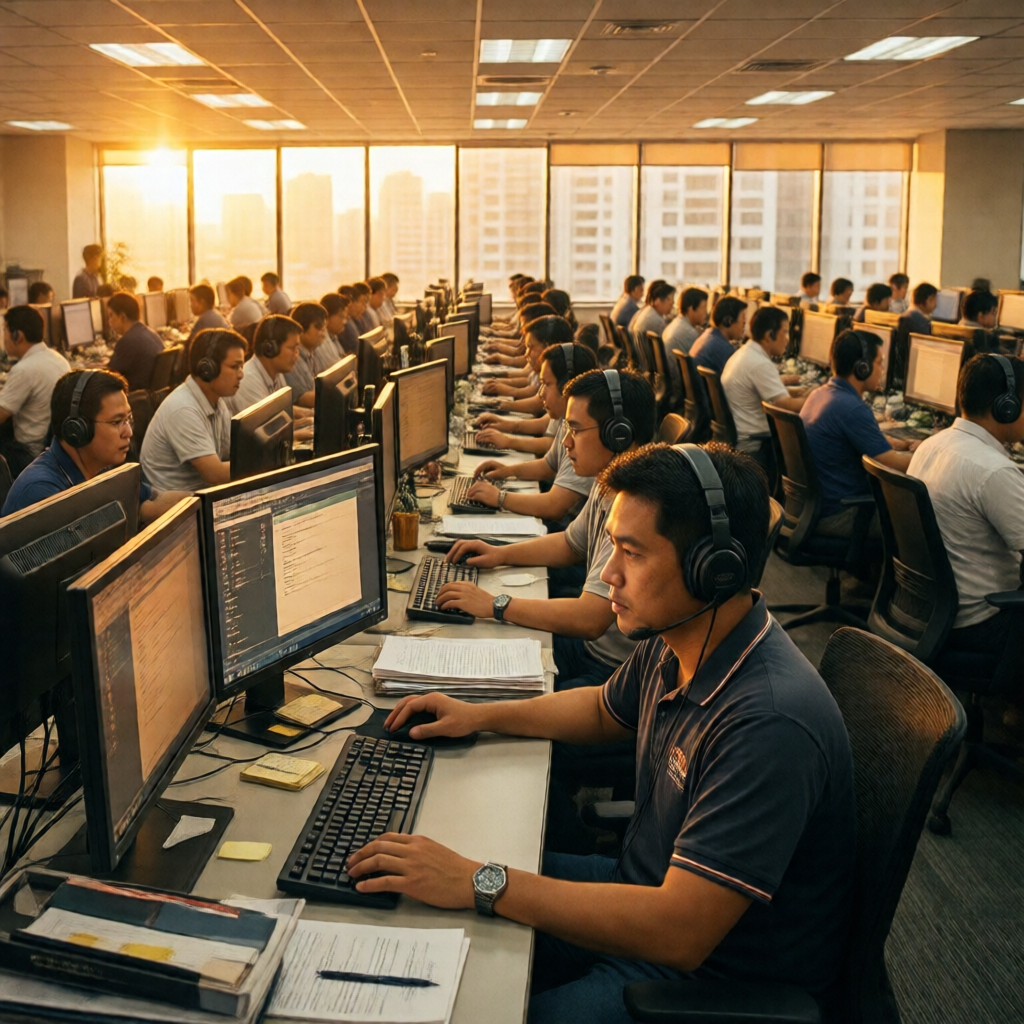 Wide-angle editorial photograph of a sunlit Manila BPO floor — rows of Filipino agents in matching b
Most cost comparisons fudge the US figure — they quote base salary only. Add employer FICA, health insurance, PTO, office overhead, and turnover replacement costs, and US in-house call center staff lands firmly at $18–25/hr. Here's the honest side-by-side.
| Location | Hourly Rate | Best For |
| Philippines (dedicated, iSuporta) | $6–10/hr | Customer-facing inbound/outbound, US brands |
| Philippines (traditional BPO seat) | $12–16/hr | High-volume, less brand-sensitive |
| India | $5–8/hr | Tech support, back-office, non-voice |
| Mexico (nearshore) | $10–14/hr | Spanish bilingual, same-time-zone preference |
| US in-house | $18–25/hr | Highly regulated industries, on-site requirement |
~$150K annual savings per 5-agent team vs US hiring
#2 English proficiency ranking in Asia (EF EPI)
The Philippines ranks second in Asia for English proficiency per EF Education First's English Proficiency Index — consistently ahead of India for customer-facing voice roles. That matters when your customers are calling from Ohio at 2pm expecting zero friction. For the full destination trade-off, the Philippines vs India outsourcing comparison and the Philippines vs Mexico guide break it down role by role.
What You Can Actually Hand Off: Inbound, Outbound & Industry Use Cases
 Tight editorial portrait of a young Filipina customer support agent mid-call — headset catching soft
Philippines call center teams handle far more than basic phone support. Here's the practical breakdown.
Inbound: Customer service and complaint resolution, order tracking and returns, tier-1 helpdesk, appointment setting, and live chat support. Filipino agents excel here. Empathy and cultural familiarity with US consumer expectations are genuine strengths — not marketing copy.
Outbound: Lead generation and qualification, follow-up sequences, collections (with compliance training), satisfaction surveys, and reactivation campaigns. Outbound demands tighter script management, but once the SOPs are locked, it runs clean.
Manila is UTC+8. A 9am–5pm EST shift means your agent works 10pm–6am locally — standard BPO industry structure, not a premium arrangement.
By industry:
-
Ecommerce: Returns processing, WISMO calls, live chat during peak hours. Dedicated agents who learn your SKU catalog are a real operational edge.
-
SaaS: Tier-1 support tickets, onboarding call coverage, trial-to-paid follow-ups. Filipino agents take well to script-based technical walkthroughs.
-
Healthcare: Appointment scheduling and insurance verification are common — but HIPAA training is non-negotiable. Confirm documented compliance protocols before signing anything.
Industry Scale The Philippine BPO industry employs over 1.3 million workers and generates $29 billion in annual revenue (IBPAP). The talent pool, management expertise, and infrastructure run deep. This is a national economic pillar — not a cottage industry.
Why Dedicated Teams Beat Traditional BPO Seats
Shared-agent BPO models are built for volume, not your brand. Agents handle 40–50 clients simultaneously, trained in batches, rotated every few months. CSAT scores slip. Brand voice drifts. And you're still paying $12–16/hr for the inconsistency.
❌ Traditional BPO
-
Shared agents across 40–50 clients
-
High turnover — agents rotated every few months
-
Trained in batches, not on your brand
-
Seat fees, setup charges, hidden minimums
-
Brand voice inconsistency is the norm
✅ iSuporta Dedicated Model
-
Agents work exclusively for your business
-
US-managed oversight and QA
-
AI-enabled workflows for speed and accuracy
-
No seat fees or hidden charges
-
Brand-trained, not pool-rotated
Dedicated agents handling only your tickets for months develop product knowledge and tone that no rotating pool can replicate. Add US-managed oversight and AI-enabled workflows, and you're not just cutting costs — you're running a sharper support operation. Explore iSuporta's customer support services to see what a dedicated team actually looks like in practice.
3 Steps to Launch Your Philippines Call Center
 Over-the-shoulder view of a US entrepreneur at a standing desk, laptop open to a six-person video gr
1 Define your scope before you talk to anyone. How many contacts per day? Inbound only, or outbound too? What hours need coverage — business hours, after-hours, 24/7? Agents are priced and matched to volume. Vague answers here cost money later.
2 Choose your model: dedicated team vs BPO seat. Defined brand voice, specific product knowledge, repeat-customer relationships — dedicated wins every time. Pure transaction volume with no brand sensitivity — a BPO seat can work, but know the trade-offs going in.
3 Onboard with SOPs, scripts, and KPIs from day one. Set AHT, CSAT targets, and FCR benchmarks before your agents take a single call. Teams without defined metrics drift. Teams with them improve — fast.
For a detailed walkthrough of hiring and managing Philippines-based support staff, the full outsourced customer support guide covers agent selection, onboarding timelines, and what a solid 30-day ramp looks like. Role-by-role salary data lives in the Philippines outsourced salary guide.
The Bottom Line Philippines call center outsourcing gives US businesses the best combination of cost, English fluency, and cultural fit in 2026. At $6–10/hr dedicated, a 5-person team saves ~$150K/year against US hiring — without sacrificing quality where it counts. Dedicated beats shared BPO wherever brand consistency matters. The talent pool, infrastructure, and management layer are all there.
Frequently Asked Questions
How much does call center outsourcing to the Philippines cost in 2026?
Dedicated agents via iSuporta run $6–10/hr all-in, versus $18–25/hr for US staff when full employment costs are factored. Traditional Philippine BPO seats cost $12–16/hr — shared agents, less brand control, built-in inconsistency.
Can Philippines call center agents cover US business hours?
Yes, and it's routine. Manila is UTC+8, so 9am–5pm EST requires an agent working 10pm–6am locally — a standard BPO shift structure, not a premium arrangement. West Coast coverage runs overnight Manila, equally common.
Is the Philippines or India better for US call center outsourcing?
Philippines wins on English fluency, US cultural alignment, and voice quality. India is cheaper ($5–8/hr) but scores consistently lower on accent and cultural fit for US consumer interactions — which surfaces in CSAT data. The full Philippines vs India outsourcing comparison breaks it down role by role.
What industries work best for Philippines call center outsourcing?
Ecommerce (returns, order tracking, live chat), SaaS (tier-1 support, onboarding calls), and healthcare (scheduling, insurance verification with HIPAA-trained agents) are the strongest fits. Outbound lead generation and collections also work well once SOPs and compliance frameworks are in place.
What's the difference between a dedicated agent and a BPO seat?
A dedicated agent works exclusively for your business — your product, your tone, your customers. A BPO seat is a shared resource split across dozens of clients. For any business where customer experience is a differentiator, dedicated is the only model that scales brand quality.
Ready to cut your support costs by 60%?
Book a free consultation with iSuporta — get a custom quote with agent profiles within 24 hours.
Bottom Line
Philippines call center outsourcing delivers the strongest ROI of any English-language staffing option for US small businesses in 2026. At $8–14/hr for dedicated agents — versus $25–35/hr domestic — the math is straightforward.
The real advantage isn't just cost. It's getting trained, brand-aligned agents who own customer relationships the same way an in-house hire would — without the overhead, benefits burden, or turnover risk.
Pick a provider with HIPAA/PCI compliance if your industry needs it, insist on dedicated (not shared) agents, and run a 30-day pilot before full commitment. Most businesses that do see measurable CSAT improvement within the first quarter.