Your Trust & Safety team is burning through $70K-per-head US moderators at 50% annual turnover. Meanwhile, a mid-sized social platform in Austin quietly shifted 80% of its content moderation queue to a Philippines-based team and cut spend by 65% — without sacrificing policy accuracy. That's not a fluke. It's exactly why the Philippines handles the majority of the world's outsourced content moderation work, and why US tech companies keep going back.
TL;DR
-
The Philippines dominates outsourced content moderation on cultural fluency — not just cost.
-
In-house US moderators run $55K–$75K/year fully loaded; Philippines outsourced rates run $8–$18/hour depending on model.
-
FOSTA-SESTA liability stays with your platform — but documented SLAs and audit trails from your BPO partner directly strengthen your compliance posture.
-
Dedicated queue models consistently hit tighter SLAs; iSuporta's US-managed model targets 97%+ policy accuracy.
Why the Philippines Dominates — and It's Not Just the Price
The Philippines leads content moderation outsourcing globally. The reason isn't hourly rate arbitrage. Filipino moderators bring native-level English comprehension and — critically — real familiarity with US cultural context, slang, regional humor, and political nuance.
 Wide-angle editorial photograph of a Filipino content moderation team at work — rows of triple-monit
That cultural fluency is what separates effective moderation from mechanical flagging. A moderator who doesn't know that "this slaps" is a compliment — or that certain US political phrases carry loaded regional meaning — produces noisy escalations and missed violations. We see this constantly when companies switch from generic offshore providers to Philippines-based teams with real policy training.
Add 24/7 shift coverage, a large tertiary-educated talent pool, and mature BPO infrastructure across Manila and Cebu. Commodity BPOs hire at throughput scale with minimal training. That's a fundamentally different product from a US-managed BPO model where escalation protocols and QA rubrics are built by US-based leads who understand your specific platform policies.
In-House vs Outsourced: The Numbers That Actually Move Budgets
$55K–$75K Fully loaded US in-house moderator/year (salary + benefits + HR overhead)
$12–$18/hr iSuporta US-managed model, all-in with built-in QA layer
Here's what the spreadsheet consistently misses: US in-house content moderation teams see 40–60% annual turnover. That number rarely makes it into budget projections. Retraining a moderator on a complex policy set costs real time and money, and the institutional knowledge that walks out the door degrades policy consistency in ways that don't surface until an enforcement gap becomes a press problem.
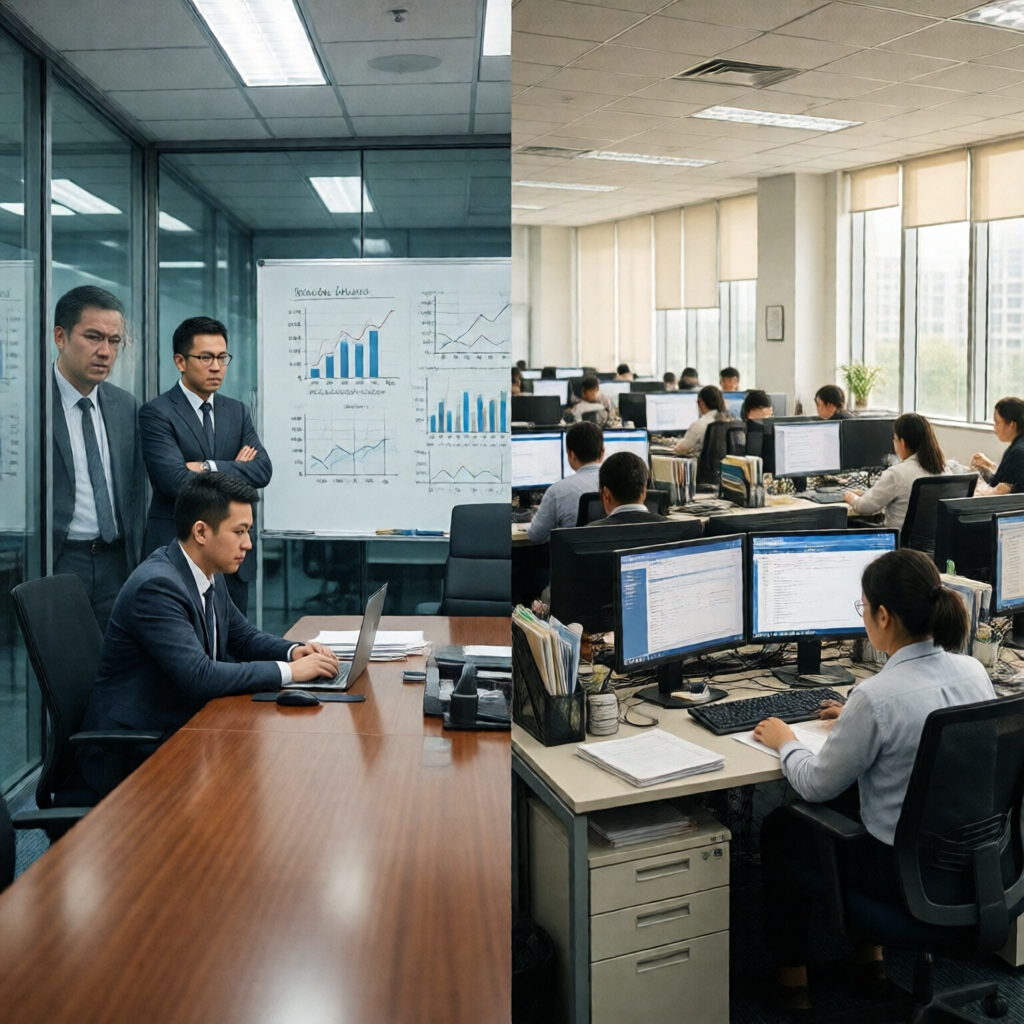 Split editorial frame — left: a glass-walled US tech office with whiteboard budget projections and s
Outsourced teams in the Philippines, when managed with real career investment, retain staff at significantly better rates. A platform spending over $1M annually on US moderation staff can realistically target $180K–$280K outsourced for equivalent throughput — from conservative commodity BPO rates through to US-managed models with QA oversight built in. For detailed rate breakdowns, see our outsourcing cost Philippines per hour 2026 guide.
"Accuracy SLAs matter as much as cost. The industry benchmark for policy accuracy sits at 95%+. If your commodity BPO isn't tracking this, you're flying blind — and your legal team will find out the hard way."
Compliance, Liability & Staffing Models — What Your Legal Team Needs to Hear
FOSTA-SESTA Doesn't Care Where Your Moderators Sit
US platforms remain liable for user-generated content under Section 230 carve-outs regardless of where moderation happens. Outsourcing does not transfer liability. What it can do is strengthen your compliance posture — if your vendor provides documented workflows, escalation matrices, and audit logs you can produce in discovery.
Commodity BPOs fall short here. Undocumented processes and informal escalation chains are liability exposure, not protection. The Philippines Data Privacy Act compliance framework for outsourcing governs how your BPO partner must handle user data — review it before any vendor agreement is signed.
Three Staffing Models — Pick the Right One for Your Volume
✓ Dedicated Queue Moderators trained exclusively on your policy set. Faster SLA, lower error rate. iSuporta's default. Right for platforms with distinct content rules or adult-adjacent categories.
⚠ Shared Queue Cheapest entry point. Moderators split across clients. Acceptable for simple, low-stakes queues — not for nuanced policy sets or platforms with legal exposure.
There's a third model worth knowing: hybrid escalation. A Tier 1 Philippines team handles standard queue volume; Tier 2 US-based senior reviewers take CSAM, legal holds, and imminent harm escalations. This is the architecture most larger platforms land on once volume and liability complexity increase together.
SLA Benchmarks to Lock Into Your Contract
💡 Did You Know? Industry SLA benchmarks: standard queue items reviewed within 24 hours; urgently flagged or viral content within 1–4 hours; CSAM or imminent harm escalations within sub-1 hour. These aren't aspirational — they're what a properly staffed dedicated queue should contractually guarantee. See our BPO contract guide for US businesses for how to structure these clauses.
Key Takeaway Your outsourced vendor's documented SLAs become your legal defense exhibit. Treat them as contracts, not estimates. If your current BPO can't produce a signed SLA with response-time guarantees and accuracy targets, that's your answer.
How iSuporta's US-Managed Model Actually Works
 Documentary-style photograph of a US operations manager leaning over a Filipino team lead's desk in
iSuporta isn't a commodity BPO. US-based operations leadership writes and owns the policy playbooks, escalation matrices, and QA scoring rubrics. Filipino moderators are hired for cultural fluency and policy comprehension — not raw throughput. That distinction matters when your platform's policies require judgment calls, not just rule matching.
Ramp time for standard policy sets runs 2–4 weeks. Complex platforms — adult content adjacency, political speech, health misinformation — need 4–6 weeks. There's natural overlap with data labeling and annotation services: the same annotation teams classifying images for automated detection can feed directly into your moderation workflow, closing the gap between human review and ML model training. Many platforms also pair this with chat support outsourcing for a unified trust & safety plus user support operation.
The Bottom Line
-
Philippines-based content moderation delivers 60–75% cost reduction versus US in-house — but only with a model that has real QA infrastructure.
-
FOSTA-SESTA liability stays with your platform; your BPO's documented workflows are your compliance paper trail.
-
Dedicated queue with US-managed oversight is the right architecture for any platform with complex or legally sensitive content policies.
-
SLAs belong in the contract, not the SOW. Lock in response-time guarantees and accuracy targets before you sign.
Frequently Asked Questions
Is content moderation outsourcing to the Philippines FOSTA-SESTA compliant?
Outsourcing doesn't transfer your platform's Section 230 liability — you remain responsible. A properly documented outsourced program with clear SLAs, audit logs, and escalation paths does strengthen your compliance posture. Ensure your BPO partner provides workflow documentation you can produce in discovery. Without it, you've added operational complexity without adding legal protection.
What SLAs should I expect from a Philippines content moderation team?
Industry benchmarks: 24-hour review for standard queue items, 1–4 hours for urgently flagged or viral content, and sub-1-hour SLAs for CSAM or imminent harm escalations. Dedicated queue models consistently hit the tighter targets; shared queues often miss them under volume spikes. Lock these into your contract — a soft commitment in an email chain is not a legal defense.
How much does it cost to outsource content moderation to the Philippines in 2026?
Commodity BPO rates run $8–$12/hour per moderator all-in. US-managed models with built-in QA oversight run $12–$18/hour — still 60–75% less than a fully loaded US in-house hire at $55,000–$75,000/year. The premium buys documented workflows, lower attrition risk, and measurable accuracy targets rather than throughput assumptions. For broader rate context, see the Philippines BPO pricing models 2026 breakdown.
How quickly can a Philippines content moderation team be ramped up?
Standard policy sets take 2–4 weeks from contract signing to live queue. Complex platforms — political speech, health content, adult-adjacent categories — should budget 4–6 weeks for proper policy training. Compressing this timeline is the most common mistake we see. The first 90 days of accuracy data are set by how well onboarding was run.
Get a Staffing Model Quote for Your Platform's Volume
Whether you're running 10,000 items/day or 10 million, iSuporta builds dedicated content moderation teams with US-managed oversight, documented SLAs, and QA accuracy targets — not shared queues and throughput promises.
✓ Bottom Line: What You're Actually Buying
-
Philippines content moderation delivers 60–75% cost savings versus in-house US teams — without sacrificing accuracy when structured correctly.
-
The difference between a $9/hour vendor and a $15/hour US-managed team is documented SLAs, dedicated headcount, and someone accountable when accuracy drops.
-
Ramp time is 2–6 weeks depending on policy complexity — compressing onboarding is the single most common cause of early quality failure.
-
Signed contracts with numeric accuracy floors and escalation paths are non-negotiable. Verbal commitments don't survive a news cycle.
Frequently Asked Questions
What content categories are hardest to moderate from the Philippines?
Jurisdiction-specific political speech, US regional legal nuance (defamation, CSAM reporting obligations), and highly contextual hate speech tied to US cultural subtext. These require additional training investment or hybrid US/Philippines reviewer escalation tiers — not a reason to avoid offshore moderation, but a reason to design your escalation path before go-live.
Is Philippines content moderation HIPAA or GDPR compliant?
Compliance lives in your contract and data handling architecture, not geography. Reputable Philippine BPOs operate under ISO 27001-certified facilities with BAA-capable agreements. Confirm data residency, access logging, and subprocessor clauses in writing before any PII touches the queue.
How do I measure whether my moderation team is actually performing?
Track three metrics weekly: accuracy rate against a sampled gold-set, false positive rate (legitimate content incorrectly removed), and appeal overturn rate. If your vendor can't produce these numbers on request, that is your answer about whether SLAs are real or decorative.