You've narrowed it down to two regions. Philippines vs Latin America outsourcing — both have real BPO industries, English-capable workforces, and a proven record with US clients. So which one actually wins for a small business that needs to hire fast, stay lean, and not babysit a remote team around the clock?
Short answer: the Philippines wins on cost and English quality. Latin America wins on time zone. Everything else is role-dependent — and that's exactly what this breakdown covers.
TL;DR
-
Philippines runs 40–60% cheaper than Latin America across most skilled roles
-
Back-office and async roles belong in the Philippines; bilingual sales belongs in LATAM
-
The 13-hour gap is a non-issue for most small business outsourcing tasks
-
Three-scenario decision rule tells you which region fits your actual needs
The Core Differences at a Glance
Five factors. No padding. Here's what separates the two regions for small business owners.
| Factor | Philippines | Latin America |
| Hourly Cost (skilled roles) | $8–$15/hr | $15–$25/hr |
| English Proficiency | Near-native; official language | Varies widely by country |
| US Time Zone Overlap | Night-shift culture bridges the gap | Strong real-time EST overlap |
| Cultural Fit with US | High — US-influenced education, media, business norms | Moderate — strong for Spanish-market brands |
| Top Role Strengths | Back-office, support, VA, accounting | Bilingual sales, nearshore dev, Hispanic market |
Key Takeaway: For most US small businesses, the Philippines delivers 40–60% lower labor costs with no meaningful English gap — making it the stronger default choice.
 Wide-angle editorial shot of a modern Manila BPO floor at golden hour — rows of Filipino customer su
What Each Region Does Best (Role-by-Role)
The right call depends entirely on what you're hiring for. Two lists. One clear pattern.
🇵🇭 Philippines Excels At
-
Customer support (voice & chat)
-
Bookkeeping & accounting
-
Virtual assistants — see Filipino VA rates for 2026
-
Data entry & transcription
-
Graphic design
-
Software development
-
Async, process-driven admin work
🌎 Latin America Excels At
-
Real-time bilingual (Spanish/English) support
-
Outbound sales requiring live EST hours
-
Creative/design for the US Hispanic market
-
Nearshore dev teams needing daily standups
-
Roles where cultural proximity is the product
Scan the Philippines column. Every single item is async-friendly and process-driven. That's not a coincidence — it's exactly the category of work small businesses outsource first. Hiring a VA, a bookkeeper, or a customer support agent? The Philippines was built for it. For title-by-title cost breakdowns, the outsourced Philippines salary guide has the numbers.
"The Philippines doesn't just have an English-capable workforce — it has an English-first workforce. That distinction matters the moment your customer sends a complaint email."
 Over-the-shoulder editorial photograph of a Filipino virtual assistant mid-video-call — two large mo
Time Zone Reality Check for Small Business Owners
This is the #1 objection. It's also mostly a myth.
Yes, the Philippines sits 12–13 hours ahead of US Eastern time. In practice, it almost never matters — because the vast majority of small business outsourcing tasks are async by design. Support tickets, admin, bookkeeping, data entry, content production: none of these require you and your hire online simultaneously. Your team handles the overnight queue. You review the results in the morning. Clean handoff. No scheduling crisis.
Philippine BPO workers routinely work US-aligned night shifts by choice — it's baked into the industry's culture and compensation expectations. The time gap only becomes a real constraint for live EST collaboration: outbound sales calls, real-time dev standups, live phone support during US business hours.
💡 Did You Know?
Industry estimates put over 90% of Philippine BPO workers on US time zone-aligned shifts — making the 13-hour gap a non-issue for most small business use cases.
Curious how this stacks up against another major destination? The Philippines vs India outsourcing comparison covers the same ground from a different angle.
$12K–$26K annual savings per hire vs. LATAM equivalent
#2 largest English-speaking country globally by population
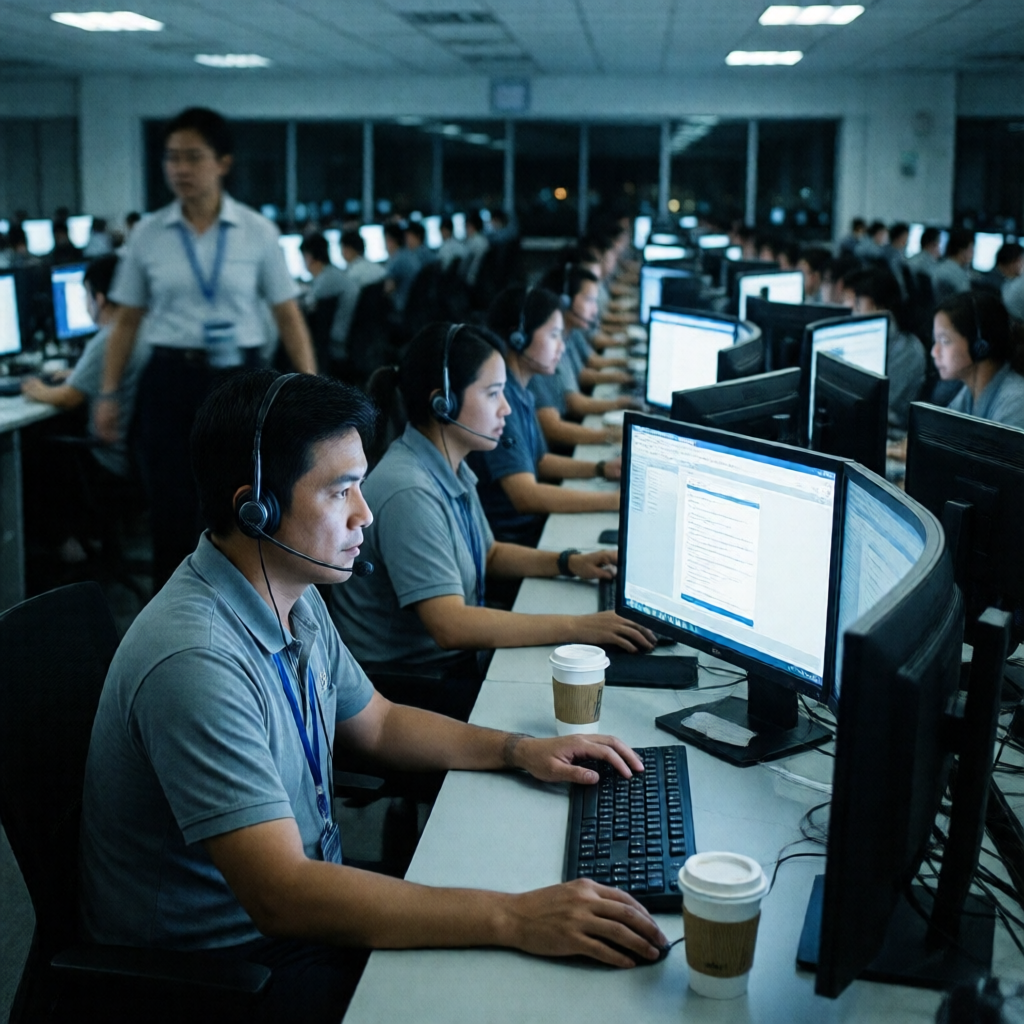 Atmospheric low-light editorial photograph of a Cebu call center at 2 AM — long rows of agents in ma
Which Should You Choose? The Decision Framework
Three scenarios. Pick yours.
Choose the Philippines if: you need maximum cost savings, your roles are back-office or async-friendly, and English quality is non-negotiable. This describes most small businesses. Before you start evaluating vendors, read how to choose an outsource agency in the Philippines — it'll save you a bad hire.
Choose Latin America if: you need bilingual Spanish/English support, real-time EST hours are genuinely non-negotiable (not just preferred), or you're targeting US Hispanic customers and cultural nuance is the actual deliverable.
Consider both if: you're scaling a support team toward 24/7 coverage. Philippines owns overnight. LATAM owns daytime. Some operators run this split deliberately — it works cleanly when scoped correctly.
The Bottom Line For US small businesses outsourcing for the first time, the Philippines offers the best combination of cost, English fluency, and BPO infrastructure. iSuporta specializes in US-managed Philippine teams — no offshore guesswork, no timezone stress, no hiring surprises.
Get a Free Quote from iSuporta →
Frequently Asked Questions
Is outsourcing to the Philippines cheaper than Latin America?
Yes — by a significant margin. Philippine labor rates run $8–$15/hr for skilled roles versus $15–$25/hr in Latin America. For a single full-time hire, that gap compounds to $12,000–$26,000 annually. For a small business watching payroll, that's real money.
Does the Philippines have a time zone problem for US businesses?
Not in practice. Philippine BPO workers routinely work US-aligned night shifts as standard — it's an industry norm, not an exception. For async roles like customer support, bookkeeping, and admin, the time difference is a genuine non-issue. Your team completes work while you sleep; you review it over coffee.
Which outsourcing region has better English proficiency?
The Philippines, clearly. English is an official language — woven into the education system and business culture through decades of US influence. Latin American English proficiency varies significantly by country and role. It can be excellent. It cannot be assumed.
The Philippines vs Latin America debate lands in the same place for most small businesses: cost and English quality point to the Philippines, with LATAM as a targeted add-on for bilingual needs. Start with whichever makes the most financial sense for your first hire.
What types of roles work best for Philippine outsourcing?
Customer support, virtual assistance, bookkeeping, data entry, content moderation, and back-office admin are the sweet spots. The Philippines has deep BPO infrastructure built specifically around these functions. Technical roles like software development and specialized finance are also viable — but vet portfolios carefully regardless of region.
Bottom Line
For most US small businesses, the Philippines wins on the two factors that matter most: cost and English quality. You get skilled, English-fluent staff at $8–$15/hr, working US hours, with proven BPO infrastructure behind them.
Latin America is the right call when you need bilingual Spanish-English coverage, strict US-timezone overlap for real-time collaboration, or cultural proximity to Hispanic markets.
The smartest operators don't force a choice — they start in the Philippines for cost efficiency, then layer in LATAM talent for specific bilingual roles as they scale.
Need to generate pay stubs for your outsourced team or US staff?
Create Professional Pay Stubs in Minutes
Whether your team is in Manila, Bogotá, or Cincinnati, iSuporta's pay stub generator handles US-format documentation fast — no accountant required.
Generate a Pay Stub Free →